I hopefully have aptly chosen the musical mood for Warsaw’s history with Chopin Waltz Op 34 No2 (Clarinet and Strings Instrumental by Richard Ames) in my VLOG. After all, Mr Chopin’s heart is in the city.
Wow – what an amazing city Warsaw is on many levels. 20 miles walking around the city over 3 days taking in The Old & New Town, Royal Route, Solidarity Avenue & The Former Jewish Ghetto. It is spectacular but also harrowing to delve more into the history
By January 1945 more than 85% of the historic centre had been completely destroyed & millions had lost their lives. But the residents of Warsaw meticulously rebuilt their city brick by brick from the rubble. Today it is a UNESCO World Heritage Site.
Onto some city history…
-
In Canon Square, you will find a church bell from 1646. It is known as the ‘Wishing Bell’ and if you walk around it whilst touching it making your wish , it will come true.
-
St. Martin’s Church is located on ulica Piwna (‘Beer Street’), the longest street in the Old Town. The church played a resistance role in the 1970s and 80s, as it was a place where opposition members gathered.
-
Stanisław Czarnowski (1873—1919) was a Polish sculptor and studied in Warsaw. This magnificent strong man sculptor sits on Brzozowa Street with a view of the Vistula River.
-
The Jesuit Church of Our Lady Mary the Merciful on Ulica Świętojańska was almost completely destroyed in 1944. However, the original architectural records survived, allowing it to be accurate restored. The church doors are impressive.
-
St John’s sits next door and became a cathedral in 1798. Stanisław August Poniatowski was coronated here in 1764. The interior is adorned with a plethora of statues and commemorations. God, Honour, Fatherland (Bóg, Honor, Ojczyzna) is one of the unofficial military mottos of Poland. An interesting plaque honours the country’s pilots.
-
You can’t miss Pelican House on the corner of Piwna Street. Built in the mid 18th century, it was home to the Royal Architect, Karl Friedrich Poppelmann.
-
Warsaw’s Old Town Market Place (Rynek Starego Miasta) is impressive, but sadly not very photogenic as it was filled with an ice rink & Christmas Market. Muzeum Warszawy takes up 11 of the houses in the square and boasts 7352 extraordinary, original and uniquely showcased objects. Give yourself a good few hours to peruse.
-
You can still see the double defensive city walls in places around the Old Town. The Barbican is one of few remaining relics of the complex network of historic fortifications that once encircled Warsaw.
Warsaw Ghetto
The Warsaw Ghetto was the largest in WW2 occupied Europe, established in November 1940 & located in the Nalewki district of the city. There were 460,000 ghetto residents at its height in an area of only 1.3 square miles. The Monument to the Ghetto Heroes (Polish: Pomnik Bohaterów Getta) commemorates the Warsaw Ghetto Uprising of April 1943. It was an act of desperation following a reign terror. A grass mound monument a few blocks away, marks the spot from where the uprising was lead by the Jewish Combat Organisation (ŻOB – Żydowska Organizacja Bojowa). Three weeks after it started, the bunker was discovered by the Nazis. Tear gas was used to try and force out the fighters. The majority chose to stay rather than surrender and committed suicide. The fighters and their commander-in-chief, Mordechai Anielewicz bodies remain here as a memorial.
Following the failed uprising, the order was given to demolish the entire ghetto. Over 100,000 died in the ghetto while in operation, and another 300,000 were transported to Teblinka death camp prior to the uprising.
The POLIN Museum of the History of Polish Jews was opened in October 2014. It was awarded European Museum of the Year in 2016. Also in the same square is a statue of Jan Karski. Jan was a Polish resistance fighter who informed the allies about the existence of death camps, and the destruction of the ghetto.
The Path of Remembrance is 16 granite blocks that commemorate the ghetto deaths. It runs from the Heroes to the Umschlagplatz Monument. The latter was the location of the Umschlagplatz railway siding where the Jews were transported to the death camp from the ghetto.
A difficult one to read, write & witness, but, nonetheless, one to remember so history doesn’t repeat itself.
Warsaw Uprising
The Warsaw Uprising broke out on 1 August 1944 & lasted 63 days. This heroic and tragic struggle was the Home Army (Armia Krajowa, AK) trying to liberate Warsaw during WW2 against German occupation. The loss of lives & destruction is unthinkable.
You can read more about this tragic event here.
The ‘Warsaw Uprising Monument’ was unveiled in 1989 in Krasinski Square opposite The Field Cathedral of the Polish Army (Church of Our Lady Queen of the Polish Crown).
Royal Route
The Roman Catholic Church of the Holy Cross / Bazylika Świętego Krzyża in Polish can be found on the Royal Route in Warsaw. It is one of the most notable Baroque churches in the capital. The sculpture of Christ carrying the cross adorns the outside. “Sursum Corda” (lift up your hearts) is the inscription. The interior is impressive.
Bombed in September 1939 and burned down during the Warsaw Uprising, it was completely destroyed. But, has since been rebuilt to its amazing former glory.
Polish composer Frédéric Chopin died and was buried in Paris in 1849. But, his heart was put in a glass jar and smuggled into Warsaw and the German’s allowed It to be put in safekeeping during the Warsaw Uprising. From 1945, it remained in a crypt at the Holy Cross Church as a holy relic. Chopin’s pickled heart was left to rest until 2014, when a group of scientists got permission to inspect the jar and investigate what he died from. Results were complications from tuberculosis.
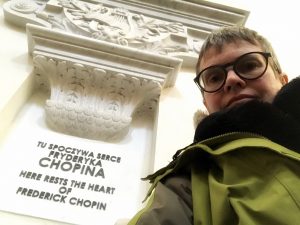
His heart was preserved initially because he was afraid of being prematurely buried. Chopin’s last recorded words were: “Swear to make them cut me open, so I won’t be buried alive.” His sister honoured the wishes and the jar was filled!

Nowe Miasto
Warsaw New Town (Nowe Miasto) lies to the north of the Old Town and is connected by Freta Street. Again, it was nearly completely destroyed during WW2 and was rebuilt from the rubble.
Buildings of interest:
-
Since 1711 the Church of the Holy Spirt has been the starting point of the annual pilgrimage to Jasna Góra Monastery in Częstochowa, a shrine to the Virgin Mary and one of the country’s places of pilgrimage. This is Poland’s holiest shrine.
-
St. Hyacinth’s (Jacek’s) Church served a a field hospital during WW2, therefore making it a target. During the bombardments over a thousand civilians and insurgents were killed here. The baroque tombstones of Adam and Malgorzata Kotowski are noteworthy.
-
St Casimir’s Church sits in the lovely square, Rynek Nowego Miasta. In 1944 it served as a Polish field hospital. Sadly, it received a direct hit from a bomb which killed over 1,000 civilians, priests, nuns and soldiers who were inside.
-
The Church of St Francis is signifance for several reasons. It holds the remains of St Vitalis in a glass coffin. It holds many religious relics that were donated by Pope Benedict XIV in 1754. The church is entered in the history books as holding the first free mass in Warsaw following the flight of its enemies at the end of WW2.
-
Tchorek plaques are a common design of memorial plaques in throughout the city. They are used to commemorate where battles or executions took place during WW2. They are based on an original design by sculptor Karol Tchorek in 1949.Many have been destroyed during changes to the city, however circa 150 remain. The plaque shown is on Długa Street.
-
Church of the Visitation of St Mary was originally built in the 15th century on the whim of a Mazovian princess. Its tower features in many historic panorama paintings of Warsaw.
-
The Old Gunpowder Depository has had several other uses, a bridge gate, prison & today a theatre.
-
Warsaw’s smallest house which is attached to the Church of the Holy Spirit now serves as a newspaper kiosk.
-
Sapieha Palace was converted to an army barracks in the 19th century and its grounds used for military exercises.
Warsaw city walls are composed of two lines: inner and outer, and several gates. They were originally built between the 13th & 16th centuries, then rebuilt in 1950 & 1963. The best preserved sections are Podwale Street, from the Royal Castle to the Barbican & onward to the banks of the Vistula River. Two statues with interesting backgrounds can be found near the Barbican:
Mały Powstaniec (Little Insurrectionist) is a statue Commemorating the child soldiers who fought and lost their lives during the Warsaw Uprising. It is reputed to be of a fighter who went by the pseudonym of “Antek” who was killed on 8 August 1944, aged of 13. Antek is wearing a helmet too large for his head and holding a submachine gun, these would have been captured from the occupying forces to use in battle.
A monument honouring Jan Kiliński, a Warsaw cobbler who became the unlikely hero of the 1794 Kościuszko Uprising. Despite being wounded twice, Kiliński and his peasant troops captured the Russian Ambassador’s Warsaw residence. This led to him being imprisoned St. Petersburg. Jan is said to embody the Polish virtues of bravery and patriotism & his statue was erected in 1936. In reprisal for an attack on the Copernicus Monument, (Copernicus was from Torun, West Prussia, so technically German heritage. When born, Torun had ceded to Poland, rendering him a citizen under the Polish crown), Nazi troops hid Kiliński in the National Museum vaults. A few days later, boy scouts smeared graffiti on the museum ‘People of Warsaw! I am here, Jan Kiliński.’ Post war, Jan was returned to his rightful place.
Opened to the public in 1727, Saski Park is one of the oldest public parks in the world – Piłsudski Square sits in the park where the tomb of the unknown solider has stood since 1925. Eerily, it is the only surviving part of the destroyed Saxon Palace in WW2. You can watch the changing of the guard every hour which is quite something.
Lech Aleksander Kaczyński is honoured in the park, he was Poland’s president from 2005 – 2010. On 10 April 2010, a plane was carrying Lech,his wife and many of Polands’s highest military & civilian leaders crashed in Russia. They were en-route to commemorate the Katyn Massacre. 96 people were killed. The Guardian newspaper ran an article in 2016 quoting that many Poles still believe the air crash was the result of Kremlin foul play.
Józef Klemens Piłsudski is also honoured & very prolific in Polish history. A Polish statesman, socialist politician, freedom fighter, and soldier. Józef commanded the Polish Legions during the WW1, served as the first Chief of State (1918–1922), Marshal (1920 ), Prime Minister (1926–1928, 1930), and leader of the Second Polish Republic (1926–1935). A busy man!
The Holy Trinity Evangelical Church of the Augsburg Confession is notable for its design. It is a classical rotunda based in part on Rome’s Pantheon. The church was the highest and at biggest buildings of 18th century Warsaw – diameter of the dome 33.4m and the height 58 meters. As such, the dome was used as a vantage point in the Kościuszko Uprising. It was also renowned for its music performances, Chopin also played here. The stained glass windows are spectacular.
The Royal Castle in Castle Square Warsaw was originally built during 1589-1619 for the King Sigmund III Vasa, from the Swedish dynasty of Vasa, ruling Poland at the time. It was rebuilt following WW2 destruction between 1974 & 1984 at huge cost. Zamek Królewski w Warszawie (Polish name) is spectacular. It has been the residence of Polish kings, president and the seat of parliament.
The castle is a protected UNESCO World Heritage Site, a historical and national monument. It is also a national museum visited by over 500,000 people every year & well worth a visit (visit free on Thursdays). Another great way to see the castle & Old Town is by climbing the 148 steps of St Anne’s bell tower (cost £1).
The Katyn Massacre victims are remembered in Castle Square. 22,000 Polish Military officers were executed by the Soviet Union during April & May 1940. The massacre was named after the forrest (Katyn) where the mass graves were first discovered.
Also in the Sqaure, you can find the remains of the Gothic Bridge. Built in the 15th century, the bridge once spanned the moat in front of the Southern Gate (Krakowska). Demolished in 1808, it was accidentally discovered in 1977, renovated and opened to pedestrians in 1983.
The rebuilding of Warsaw after World War II coincided with emergence of socialist realism. As a result, the area around Marshall Street (shopping & commercial), the buildings have the architecture style of the communist era. I didn’t have much time to explore this area, however, a must is to witness the Palace of Culture. This monolithic building was a gift to the city from the Soviet Union under the initiative of Jospeh Stalin. It was built in 1955, designed by Russian architect Lev Rudniev. Standing at 30 stories high, took 400 million bricks, stands just over 230m and is the tallest building in Poland. I felt as thought Batman was just about to appear!
Over 5,000 workers from the Soviet states were bought in and worked around the clock. It took them just three years to complete. Stalin didn’t live to see the end result. Take the lift to the 30th floor for amazing city views. Or, my suggestion would be to visit the Marriott Hotel Sky Bar, take in a cocktail and enjoy the view from here for the same price!
Monument to the Heroes of Warsaw, AKA Warsaw Nike. In ancient Greek religion, Nike was a goddess who personified victory. The statue is a woman reclining, rising up with a sword raised above her head in her right hand and her left hand also raised. The monument commemorates all those who died in the city in 1939 – 1945.
On the 7 November 1867, Maria Skłodowska was born at 16 Freta Street in Warsaw. She later became Marie Curie. The only female to receive the Nobel Prize twice, and the only winner in history honoured in two different fields of natural sciences – physics and chemistry.
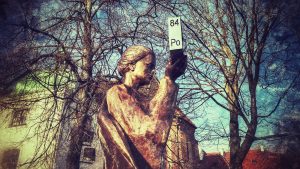
The discovery of radioactivity by Henri Becquerel in 1896 inspired Marie and her husband, Pierre, in their researches and analyses. This led to the isolation of polonium (PO84), named after the country of Marie’s birth, and radium. Marie Curie developed methods for the separation of radium from radioactive residues in sufficient quantities to allow for its characterisation and the study of its properties.
Marie actively promoted the use of radium to alleviate suffering and during World War I. She was also known to carry test tubes of radium around in the pocket of her lab coat. Marie died on July 4, 1934, of aplastic anaemia, believed to be caused by prolonged exposure to radiation. The house is now an exhibition of her life’s amazing work. Well worth a visit.
Hotel Bristol, built in Neo-Renaissance style, was opened in 1901. It is located on the historic Royal Route, next to the Presidential Palace. After Poland gained its independence in 1919, Paderewski became the Prime Minister and held the first session of his government at the (his)hotel.
Upon the German invasion in 1939, the hotel was made into the headquarters of the Chief of the Warsaw District. It miraculously survived the war relatively unscathed, unlike the rest of the city. It stood nearly alone among the rubble of its neighbourhood. After the fall of Communism in 1989, the hotel was finally restored it to its former glory. The original interiors of the public rooms were recreated to match the 1901 designs. The Bristol was reopened in April 1993 – Maggie Thatcher attended! Throughout its history, the hotel has hosted many famous guests which are listed on the lobby wall.
If you can’t afford the price tag, a visit to Cafe Bristol, styled on fine pre-war Viennese coffeehouses, is a must and actually not that expensive… yummy
The Royal Route (Trakt Królewski) is a former communication route that led southward from the Old Town. It now boasts many impressive historic buildings & statues. The route begins at Castle Square & heads down Krakowskie Przedmieście.
Sigismund’s Column (Kolumna Zygmunta), commemorates King Sigismund III Vasa. He holds a cross in one hand & a sword in the other. Originally erected in 1644, he sits in Castle Square at 22m high. It is one of the city’s most famous landmarks. It is the first secular column monument in modern history, and glorifies the king in a way that was usually only used for saints.
St Anne’s Church is one of Poland’s most notable churches. It is one of the city’s oldest buildings as she survived the war with minimal damage apart from a collapsed roof. The church has remained unchanged since 1788. The interior was the most impressive of the city’s churches for me, not just because it is my namesake! It boasts a an original trompe l’oeil ceiling, a rococo high altar and a spectacular organ – a concert is played at noon between mid-April and October.
Adam Mickiewicz’s Monument can be found outside the Carmelite Church. Adam was a Polish poet, dramatist, essayist, publicist, translator, professor of Slavic literature, and political activist. He is regarded as a national poet in Poland and Lithuania. The church is also known as the Church of the Assumption of the Virgin Mary and of St. Joseph. It is most notable for being the site of Chopin’s first employment – he was invited to perform a recital on the church’s organ. Chopin also studied at the University of Warsaw (which can be found on the Royal Route) from 1817 – 27.
The Presidential / Namiestnikowski Palace was built in the 17th century for Commander Stanislaw Koniecpolski. Since 1994 it has been residence of Polish presidents. In 1955 the Warsaw Pact was signed here and in 1974 the treaty regulating Polish-German relations. Infront of the palace there is monument to Duke Jozef Poniatowski (1763 – 1813. The Duke was a Polish leader, General, Minister of War and Army Chief, who became a Marshal of the Empire.
Jan Twardowski Sqaure is a nice respite. Jan Jakub Twardowski (1915 – 2006) was a Polish poet & Catholic priest. Bolesław Prus (pen name) accompanies him, born Aleksander Głowacki. He was a leading figure in the history of Polish literature and philosophy. He suffered severe battle wounds as a 15 year old in the 1863 Uprising and was imprisoned.
Church of St. Joseph of the Visitationists is one of the most notable Rococo churches in the city. Its construction begun in 1664 and completed in 1761. Outside sits Cardinal Stefan Wyszyński, primate of Poland from 1948-81.
The Nicolaus Copernicus Monument in Warsaw stands in front of the Staszic Palace, the seat of the Polish Academy of Sciences. He was an astronomer, mathematician, translator, artist, and physicist to name a few! Nicklaus is best known as the first astronomer to suggest the sun was stationary in the center of the universe and the earth revolved around it.
Give yourself lots of time to explore the area, there is lots to see.
Warsaw hints & tips
Warsaw gets 10/10 from me – one of the top European city breaks I have done. A friendly city that’s had a torrid past, being rebuilt from the ashes after WW2 when it was 90% destroyed. It holds a plethora of history, amazing architecture, clean, safe, value for money, easy to get to, excellent city transport, great food and drink experiences and photograph opportunities around every corner.
For you foodies – you will see pierogi on most menus. Filled sweet or savoury dumplings, both delicious, however, the gravy (bacon fat / lardons / onions) is not for you if you are on a diet! The main meals are large & usually feature a rather large duck or pork knuckle – try sharing! And Polish apple cake come in many forms & rather yummy…
Accommodation recommendation – AAA Stay Check out 3rd party supplies for costs, I used Expedia.
WPT1313 offer city tours in retro vehicles which would be fun – one for next time…
If you do wish to use a taxi, Uber in Warsaw is efficient & very cheap.
Airport transfers, MM Fly Away excellent service & prices.
You can visit loads of Warsaw museums and galleries for free each day. Click the link for more details, where you can also found out loads more tourist info.
Dziękuję (thank you) Warsaw.
